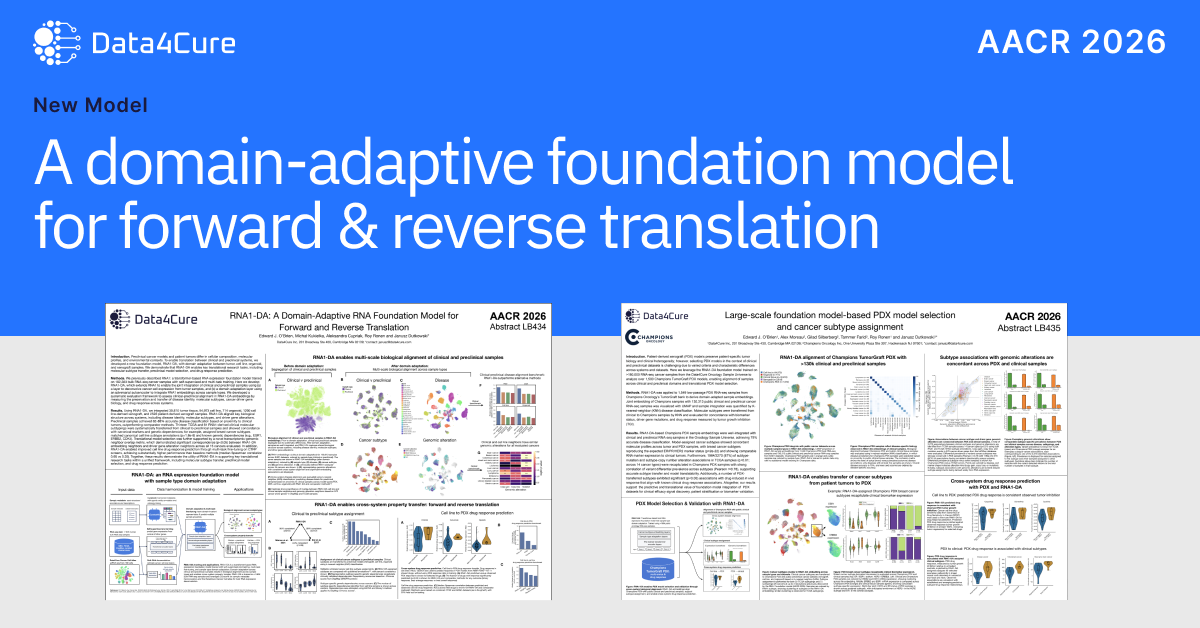
Data4Cure is presenting two late-breaking poster abstracts at the 2026 American Association for Cancer Research (AACR) Annual Meeting in San Diego. Both posters demonstrate new capabilities of RNA1-DA, a domain-adaptive version of Data4Cure's RNA1 foundation model, for bridging clinical and preclinical cancer biology.
Poster 1 — RNA1-DA: a domain-adaptive RNA foundation model for forward and reverse translation
Preclinical cancer models and patient tumors differ in cellular composition, molecular profiles, and environmental context. These differences make it difficult to translate findings between systems — whether selecting the right preclinical model for a clinical question (reverse translation) or predicting clinical outcomes from preclinical data (forward translation).
RNA1-DA addresses this by extending RNA1 with two new components: a deconvolution layer that separates cancer-cell expression from bulk tumor samples, and a domain-adaptation layer that aligns embeddings across tumor tissue, cell lines, organoids, and xenograft samples. Key results from integrating over 130,000 samples across clinical and preclinical systems:
- Disease-level integration — preclinical samples achieved 62–88% accurate disease classification based on proximity to clinical tumors, outperforming comparator methods.
- Subtype transfer — 13 TCGA and 61 RNA1-derived molecular subtypings were transferred from clinical to preclinical samples, with concordance to canonical markers and genetic dependencies.
- Drug-response prediction — multi-task fine-tuning on drug screens led to predictions significantly outperforming baseline methods.
Poster 2 — Large-scale PDX model selection and subtype assignment, with Champions Oncology
In collaboration with Champions Oncology, Data4Cure applied RNA1-DA to a large cohort of over 1,500 low-passage patient-derived xenograft (PDX) models from Champions' TumorGraft bank. By embedding Champions' PDX samples jointly with 130,313 public clinical and preclinical RNA-seq samples from the Data4Cure Oncology Sample Universe, RNA1-DA enables translational model selection and molecular subtype assignment at scale.
- Sample integration — Champions PDX embeddings achieved high disease-classification accuracy when integrated with the Oncology Sample Universe.
- Subtype concordance — model-assigned breast cancer subtypes reproduced expected ER/PR/HER2 marker status with RNA marker expression comparable to clinical tumors.
- Genetic validation — 87% of subtype–mutation and subtype–copy-number associations found in TCGA were recapitulated in matching Champions PDX samples.
- Drug response — multiple PDX-transferred subtypes showed significant associations with in vivo drug response aligning with known clinical patterns.
Why this matters
Together, these posters demonstrate that RNA1-DA provides a unified framework for key translational tasks: molecular subtype transfer between clinical and preclinical systems, data-driven preclinical model selection, and drug-response prediction. The Champions Oncology collaboration further validates the approach on a large, independent PDX cohort — supporting clinical efficacy-signal discovery, patient stratification, and biomarker validation. Both posters build on the Biomedical Intelligence Cloud and the Oncology Sample Universe, which integrates over 130,000 harmonized cancer RNA-seq samples across 25 cancer types.
Posters were presented at AACR on April 22, 2026 (9:00 AM–12:00 PM), Exhibit Hall Section 52. Read the press release.